
No Compromise - Daniel 1:3–21
20th century pastor A.W. Tozer wrote the following about compromise in the church: “Christianity today is so entangled with this present world that millions never guess how radically they have missed the New Testament pattern. Compromise is everywhere, but, actually, no real union between the world and the Church is possible. When the Church joins up with the world, it is the true Church no longer but only a pitiful hybrid thing...an object of smiling contempt to the world and an abomination to the Lord! Nothing could be clearer than the pronouncements of the Scriptures on the Christian's relation to the world. The confusion that gathers around this matter results from the unwillingness of professing Christians to take the Word of the Lord seriously.

“Compromise is everywhere,” Tozer says.When have you compromised the standards put forth in God’s Word? The standard of holiness, of love, of forgiveness, of self-discipline, of morality, of faith? We often compromise under the pressures of the world.
But Jesus Christ never did. He was a sufficient Savior, standing in for His people. He lived a righteous life in the place of those He would save. And because Jesus did not compromise under the pressure, His church must stand strong. It will not be easy, and our efforts will not be perfect. But still, we cannot accept compromise when it comes to either the law or the gospel of God.
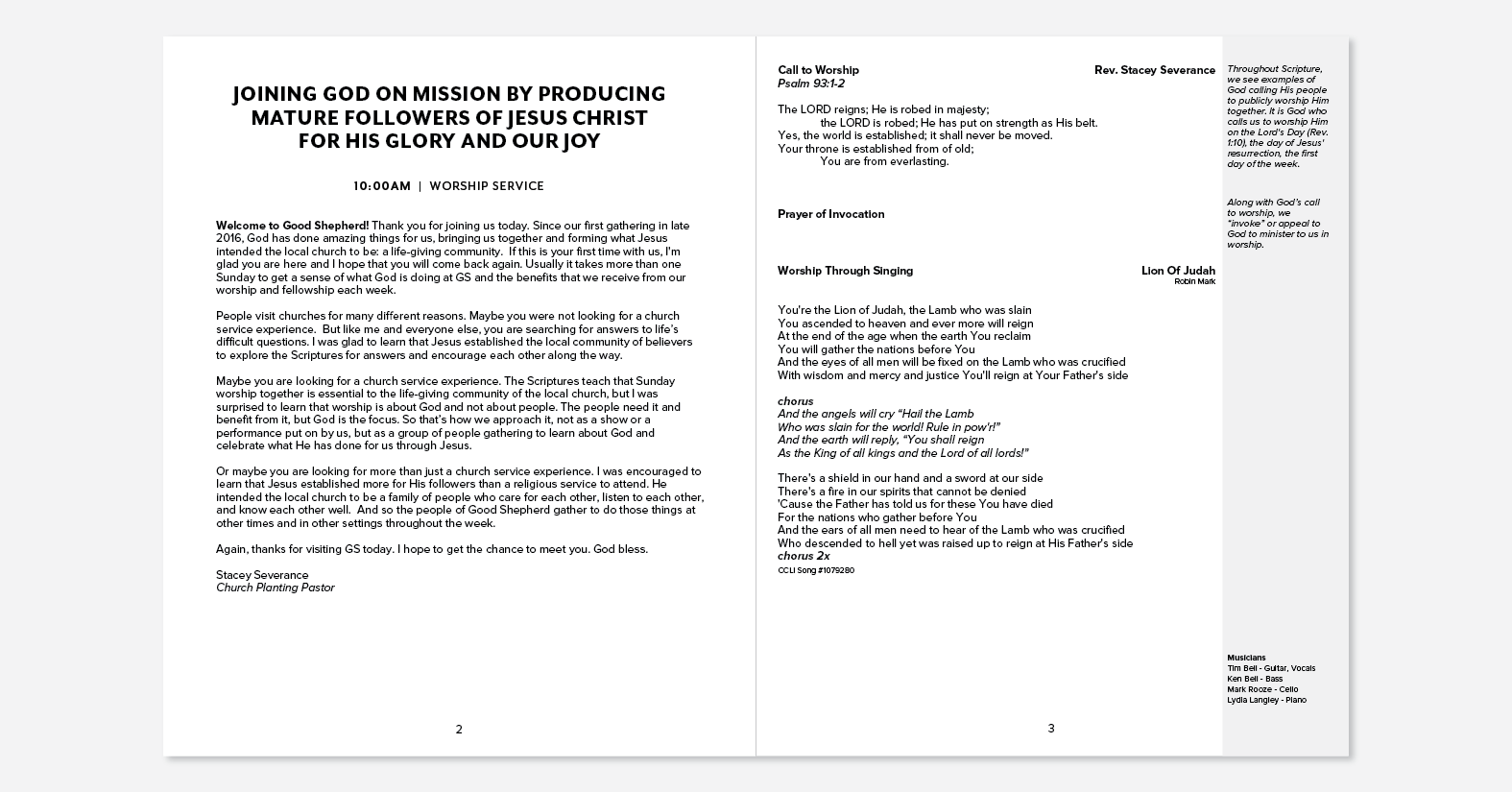
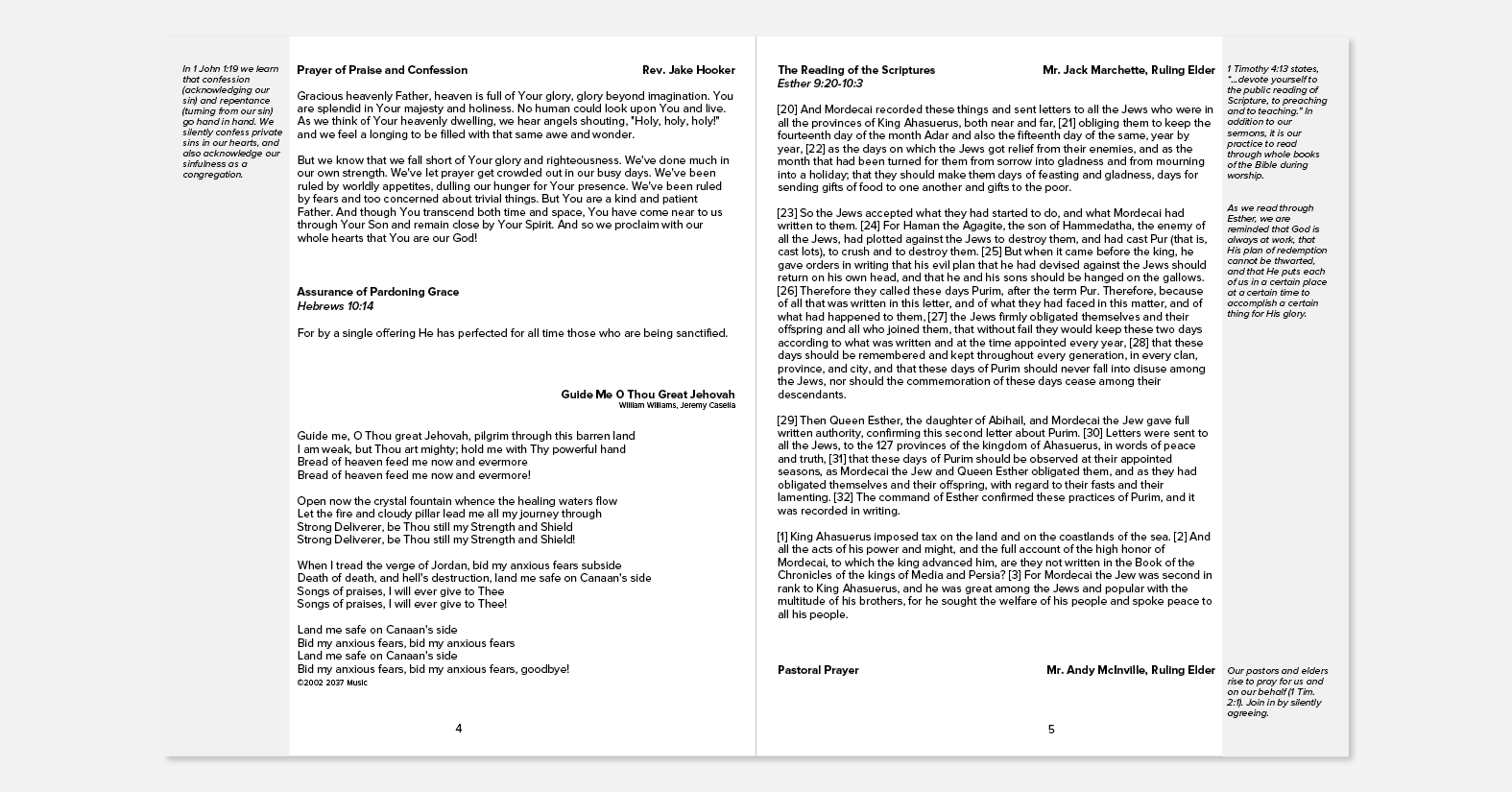
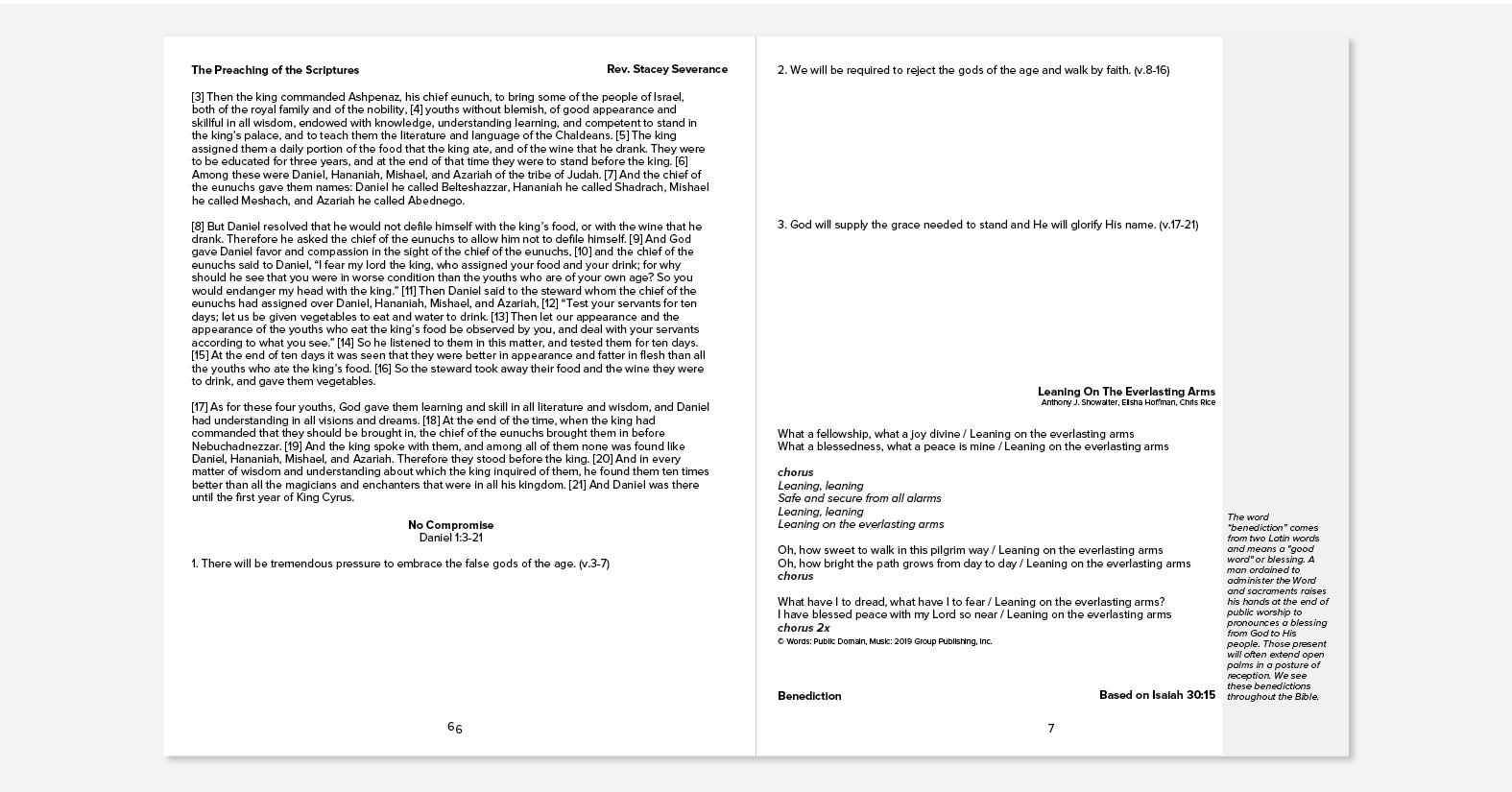
We must stand, trusting in our sovereign God. But what should we expect as we attempt to stand strong? The rest of Daniel chapter 1 explores the answer to that question. You can find three answers to the question on pages 6 and 7 in the worship guide. We should expect that: There will be tremendous pressure to embrace the false gods of the age, we will be required to reject the gods of the age and walk by faith, and God will supply the grace needed to stand and He will glorify His name.
We saw last Lord’s Day that the book of Daniel begins with a description of yet another stage in the downfall of the nation of Israel. Once a proud nation under the government of Yahweh - the only true and real God - the Israelites continually turned to the worship of false gods, and as a result, Yahweh withdrew His favor from them (as he said he would).
As God withdrew His favor, Israel split into a Northern and Southern kingdom. God then allowed the Northern kingdom to be conquered by the Assyrian empire in 722 B.C., and now here in Daniel 1, in the year 605 B.C., we see the Babylonians (who defeated the Assyrians to become the premier world power) begin their invasion of the Southern kingdom.
In all, the fall of the Southern kingdom was a process that took about 19 years to complete. Nebuchadnezzar, the eventual king of Babylon, besieged the city of Jerusalem, taking prisoner the Israelite king and robbing their temple of many treasures.
Nebuchadnezzar took these treasures from Yahweh’s temple and placed them in the temple of his false, pagan gods as a proclamation that his god had given him the victory. And as I said last week, a continual theme of Daniel is the reality that the LORD reigns, that Yahweh is completely sovereign, always in control, and nothing happens apart from His eternal decrees. The Israelites, some of whom were continually faithful to God, went into exile along with the unfaithful, and those faithful believers were forced to walk by faith as God’s redemptive plans unfolded.
Here we see that the next step of Nebuchadnezzar was to take the higher-ups from among the Israelites and many young people with potential and to begin an initiative for reprogramming them, so to speak. The goal was to assimilate them to Babylonian culture and religion over a three-year period.
Look again at the end of verse 4. They would be taught, “the literature and language of the Chaldeans. [and] [5] The king assigned them a daily portion of the food that the king ate, and of the wine that he drank.” Now, many Israelites were chosen for this program, but verse 6 notes that [6] Among these were Daniel, Hananiah, Mishael, and Azariah of the tribe of Judah.” “Tribe of Judah” indicated that these were young men ascended from King David.
Important to see here is that the name of each young man contains a component related to Yahweh, the covenant God of Israel. Daniel’s name means “God is my Judge.” Hananiah means “Yahweh is gracious.” Mishael means “Who is what God is?” and Azariah means, “Yahweh has helped.” These young men loved and honored Yahweh. They were faithful to the one true God.
Certainly, each man’s name meant something to him. But look at what Nebuchadnezzar’s servant does. Verse [7] And the chief of the eunuchs gave them names: Daniel he called Belteshazzar, Hananiah he called Shadrach, Mishael he called Meshach, and Azariah he called Abednego. Archeologists recognize that these new names contained the names of the Babylonian gods. These young men received new names, as if to say, “Nevermind Yahweh. You’re in Babylon now. Disregard the ways of your old God. You serve a new god now.” With the new names and new information in a new location this was full-scale indoctrination. This was to be for you these men, in many ways, a re-learning of the world. Now, if you’re Daniel or any other faithful Israelite, you know that this invasion is the will of God.
I mentioned last week that Deut. 31 and 32 stated the warning, also Leviticus 26, that if Israel turned to false gods, eventually Yahweh would scatter their nation. Daniel 1 describes this scattering.
Imagine that the life your God has chosen for you is life in a foreign land, in a world that runs contrary to the ways of your God. It shouldn’t be hard to imagine if you are a follower of Jesus Christ.
There has always been, from the days of Adam and Eve, to the present day, tremendous pressure to embrace the false gods of the age. There has been and will continue to be a constant force attempting to persuade you and I to turn from the living God.
We should expect it. We should not be surprised. In John 17 in the NT, Jesus says his followers will be “in the world” but are not “of the world.” In 1 John 2, John the apostle writes, [15] Do not love the world or the things in the world.” By “the world,” he means the system of thinking and living that goes against God. Nebuchadnezzar aimed to systematically change the minds and lives of God’s people.
Is there not, in our world today, a system of thinking and living that runs contrary to the ways of the God of Scripture? Of course there is. This is why Tozer could rightly say that compromise is everywhere. What are the false gods of the age in the year 2020? Well, there are many. We live in a secular age, where God is largely dismissed. We live in an individualistic society, where personal fulfillment is the highest ideal, where sacrifice and duty are considered old-fashioned. Personal achievement and self-reliance are prized. In the 21st century, man is god.
This is why much of what is called “the church” is so man-centered in its doctrine and practice. This is why the sovereignty of God in all things is often scoffed at. This is why the standards of God are often compromised. The pressure is tremendous. Where have you bowed to the false gods of this age? The opportunity to compromise is there.
But God’s people must step out on faith. Notice verse [8] But Daniel resolved that he would not defile himself with the king’s food, or with the wine that he drank. Therefore he asked the chief of the eunuchs to allow him not to defile himself. The Israelites had dietary laws given to them by God. God created eating restrictions for the nation of Israel as a way of barring them from table fellowship with pagan nations.
Keep in mind that God separated the Israelites from the world in order to teach them His ways. Certain foods deemed “unclean” by God. To eat something unclean defiled a person. That kind of defilement could be in view here, at least in part, but it seems that Daniel did not always abstain from everything the Babylonians ate and drank during his time there.
Rather, his abstinence at this point was a form of protest. His denial of Babylonian delicacies was an effort to differentiate himself from the Babylonians and demonstrate his dependence on Yahweh alone. Notice verse [9] And God gave Daniel favor and compassion in the sight of the chief of the eunuchs. Apparently the chief eunuch liked and respected Daniel. He wanted to allow Daniel to live according to his principles.
But at the same time, the chief is worried about what the king will do to him if he does not enforce this edict. So look at what Daniel says to him in verse [12] “Test your servants for ten days; let us be given vegetables to eat and water to drink. [13] Then let our appearance and the appearance of the youths who eat the king’s food be observed by you, and deal with your servants according to what you see.” [14] So he listened to them in this matter, and tested them for ten days.
This is an enormous step of faith for Daniel and these three other young men. Some scholars believe that God may have given Daniel a revelation that led him to do this, but nonetheless, he had to venture out by faith. The chief eunuch agrees, and after 10 days, Daniel and the three others, you see there, “were in better appearance and fatter in flesh than all the youths who ate the king’s food.” They were not emaciated or malnourished. They were in superior shape. And the eunuch is no fool. He puts everyone on the Daniel diet! But these others are forced to do it; they don’t do it by faith.
This is timely given our efforts as a church to pray and fast this month. We are abstaining from a couple meals or from something else that we might hunger more for God. Do you know what it means to “hunger for God?” Psalm 37 says, “Delight yourself in Yahweh.” We delight in food and drink and other things.
But the followers of Jesus must also delight in our God. We must be satisfied in Him. There must be times for God’s people where we abstain from the good things of the world and demonstrate our dependence on the Lord. Deuteronomy 8 in the OT describes how God explained the reason for the Israelites wandering in the wilderness. God says, [2] you shall remember the whole way that Yahweh your God has led you these forty years in the wilderness, that he might humble you, testing you to know what was in your heart, whether you would keep his commandments or not. [3] And he humbled you and let you hunger and fed you with manna, which you did not know, nor did your fathers know, that he might make you know that man does not live by bread alone, but man lives by every word that comes from the mouth of the LORD.
Our God is our life. Our aim must be that He would be our greatest delight if we would glorify Him in the world.
Are you willing to put things aside for a season that you might know the Lord more? What is prayer and quiet time in the Word but abstaining from whatever else you might do? To put down that or turn from this and say, “God, give me more of You.” We must do this if we would live by faith in the world. And will we stand? Yes, with God’s help.
Look at these final verses. God blesses these four young men of faith in very special ways. He sets them apart among their peers. Notice verse [17] “As for these four youths, God gave them learning and skill in all literature and wisdom, and Daniel had understanding in all visions and dreams.” When they went before Nebuchadnezzar, verse 20 says, “he found them ten times better than all the magicians and enchanters that were in all his kingdom.”God supplied the grace they needed - the undeserved favor necessary - for them to stand and He glorified His name.
I mentioned last week that by the end of Daniel chapter 4, Nebuchadnezzer will be humbled before God. And you see a foreshadowing in verse 21 that Nebuchadnezzer does not reign forever. It says, “And Daniel was there [in Babylon] until the first year of King Cyrus. Babylon fell to Cyrus and the Persian empire in 539 B.C.
Daniel lived most of his life in exile. 66 years under Babylonian rule. 66 years walking by faith in a foreign land. 66 years relying on the grace of God to stand. 66 years depending on Yahweh to glorify His name and sustain His people. But when Cyrus comes into power 66 years later, Daniel’s religion has not been erased. It lasted, as it must always last, and it always has and always will because it is the truth of the one true God. His people will remain, but the righteous must live by faith.
Who knows how God will sustain His people or what we must face, but we should expect the need to walk by faith under the pressure to turn from God.
Now, you may feel that you are strong in your convictions, and perhaps you are. But where in your life are you pressured to compromise the gospel? Where do you compromise the law of love? To follow Jesus means to lay down your life, to take up your cross, not seeking to be served but to be a servant.
The gospel tells us that we have unimaginable forgiveness through Jesus Christ. Therefore, we must forgive. The gospel tells us that through Jesus, the unlovable are loved, the unacceptable are accepted, the unclean are made clean. Do you compromise these truths, either when you look at those around you or when you look in the mirror? “Compromise is everywhere.”
But I know one place it was not. There was no compromise at the cross of our Lord. Jesus bled and died for the compromisers whom He loved. Reach for Him. He is there.
Let’s pray together.