
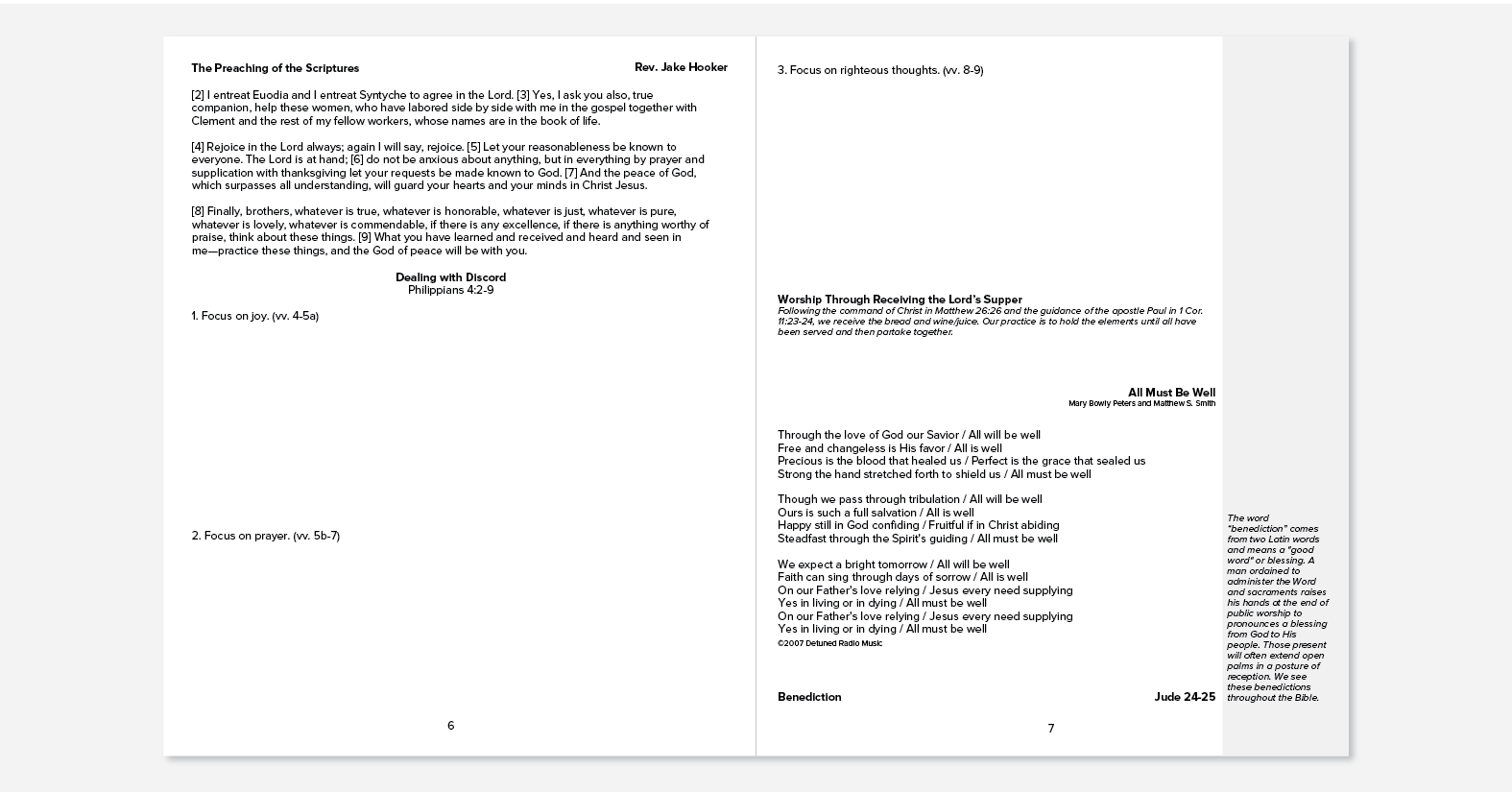
Dealing with Discord - Philippians 4:2-9
How do you handle conflict? Do you avoid it? The conventional wisdom is to deal with it directly and quickly. You need to take decisive action before the conflict gets worse.
One article I read gave this advice: “By actually seeking out areas of potential conflict and proactively intervening in a just and decisive fashion you will likely prevent certain conflicts from ever arising.”
This is the standard piece of advice for dealing with conflict in the workplace. But it’s also how most parents approach dealing with conflict with their children.


You want to address potential points of conflict before they develop into a full blown argument. At the end of the day, there are thousands of ways to handle conflict and every situation is different.
But what we have in our passage is really quite interesting. Paul gives direction for a conflict within the church of Philippi, but he doesn’t really deal with it directly. He certainly mentions it, but he doesn’t resolve it.
Paul doesn’t really seem to handle this conflict according to conventional wisdom. He mentions it, requests help, and moves on.
He wants to see the church in Philippi maintain unity, but is this the best way to handle it? In chapter 2, Paul exhorts the church to pursue unity, and here in chapter 4, he addresses discord in the life of the church.
Look at verse 2 with me.
Paul entreats Euodia and Syntyche to “agree in the Lord.” He’s pleading with them to lay down their disagreement even though it’s clear that these two women were strong believers. In fact, Paul says that they labored with him “side by side” in the gospel along with a man named Clement.
It’s clear that Euodia and Syntyche had a lot of influence in the church, so much so that Paul enlists the help of a “true companion” to resolve their differences.
Many scholars believe that the Greek word for “true companion” is someone’s name. Syzygos, the Greek word translated as “true companion” literally means, “yoke fellow.” In other words, Paul is telling Syzygos, whose name literally means “bringing together,” to help unite these ladies.
And with that, Paul moves on.
What’s remarkable to me in this passage is the change in direction from verse 3 to verse 4. Paul goes from addressing conflict to giving encouragement.
Focus on Joy (vv.4-5a)
And really, it’s not just any encouragement. Paul tells the church to rejoice on the heels of addressing conflict. Look at what he says in verse 4, “Rejoice in the Lord always; again I will say, rejoice.”
He’s not encouraging them to rejoice, he’s actually commanding it. How do you command people to feel a certain emotion? Seems impossible, right?
Sometimes you might tell someone, “Don’t be sad, be happy.” But even when you say something like that, you know that you have no control over what someone else is feeling.
But for the Christian, finding joy is different. Because your ability to rejoice doesn’t rely on you generating an emotional response, rather it resides in your ability to reflect on what God has done for you.
I read about a couple in Tulsa Oklahoma who helped eliminate all the medical debt in Tulsa county. They raised 28 million to do it. They did it in the middle of a pandemic when people are struggling to make ends meet - knowing that there is no longer any medical debt hanging over their head was a huge blessing.
But think about this: What if you had medical debt but refused to acknowledge it? You pretended like it didn’t happen and the debt didn’t exist and someone came rushing up to you and said, “All the medical debt has been cancelled!” Well, you wouldn’t rejoice because the news would have no impact on you.
But if you knew you had debt and found out it was forgiven - you’d certainly rejoice! No one would have to encourage you to rejoice because you’d already be doing it!
Joy isn’t an emotion you muster on your own. Joy will come into your heart when you recognize the beauty of what Christ has done for you. How he’s taken away your sins.
The Christian can be commanded to rejoice because they’re not rejoicing in anything they have done. Rather, they’re rejoicing in the one who has already done it.
Paul commands believers to not only experience joy internally, but to externally demonstrate their joy. How? By demonstrating their “reasonableness” to everyone. What does Paul mean by “reasonableness?” He’s referring to a spirit of kindness. One commentator calls it “big-heartedness.”
Again, a charitable spirit flows out of your relationship with Christ. Your ability to get along with others shows that God is at work in you.
But here’s what’s incredible about Christian joy and your ability to be charitable: Because it resides in the work of Christ, it’s not dependent upon your circumstances.
Paul makes it abundantly clear that your joy shouldn’t be controlled by the events going on around you.
It’s easy to let your circumstances dictate your happiness. Not only can your circumstances dictate your joy but they can also determine the way that you treat others.
What’s your source of joy: The work of Christ in your life, or when everything in life seems to be going your way?
Verse 4 is even more incredible when you consider Paul’s circumstances. He was imprisoned. His life was hanging in the balance. He experienced horrible circumstances and yet he had joy.
Paul had joy in the Lord.
Focus on Prayer (vv. 5b-7)
But everyone here has faced difficult circumstances to varying degrees. Paul certainly understood that life is hard. And in those moments it’s difficult to rejoice, even in the Lord.
But Paul addresses this in verses 6 and 7. He writes, “The Lord is at hand; 6 do not be anxious about anything, but in everything by prayer and supplication with thanksgiving let your requests be made known to God. 7 And the peace of God, which surpasses all understanding, will guard your hearts and your minds in Christ Jesus.”
Paul reminds us that we don’t know when the Lord will return. It could be at any minute! And it shouldn’t make us anxious. Rather, we should turn to God in prayer. There’s even a promise associated with taking your cares to God in prayer: You’ll receive the peace of God that passes all understanding. And it will guard your hearts and minds.
There’s an obvious implication from these verses: God wants you to go to him in prayer. He wants you to bring to him the things that are weighing on you.
The truth is the all-powerful, all-knowing, sovereign creator of the universe wants to hear your prayers. But if God is sovereign and already knows the future, why pray?
The Westminster Shorter Catechism defines prayer like this: Prayer is an offering up of our desires unto God, for things agreeable to his will, in the name of Christ, with confession of our sins, and thankful acknowledgment of his mercies.
Here’s the secret to prayer: It’s about aligning our will with the will of God rather than trying to convince God to do what we want him to do.
That’s certainly not to say you can’t pray for what you want, but you need to be prepared for God to say “no.” If God says “no,” will you still think he’s good? Do you really believe that God knows what’s best for you?
Your kids might want chocolate chip cookies for dinner every night but that’s not what’s best for them. They need a well balanced diet. You’re actually a good parent for refusing to give your children what they want. That doesn’t mean you’re a mean person, it just means you know what’s best. And sometimes giving them what they want actually does them harm.
When God doesn’t respond to your prayers the way in which you would like, perhaps what you want isn’t what’s best for you.
In many ways, prayer is giving up control. You’re admitting your inability to control your circumstances and God’s complete control over all things. And there’s peace in the midst of that.
Jesus even said do not be anxious in Matthew Chapter 6 when he said, “Look at the birds of the air: they neither sow nor reap nor gather into barns, and yet your heavenly Father feeds them. Or consider the lilies of the field, how they grow: they neither toil nor spin, 29 yet I tell you, even Solomon in all his glory was not arrayed like one of these.”
How does Jesus end that passage? “But seek first the kingdom of God and his righteousness, and all these things will be added to you.”
In conflict you’re trying to get your way. Maybe a better way to say it is - you’re trying to accomplish your will. You’re seeking to accomplish your will. And even when you get your way - rarely is it satisfying. You really don’t feel peace.
It’s because true peace, the peace that passes all understanding is only found when you’re prostrated before the Lord. The peace that passes all understanding is rooted in your ability to sincerely say, “not my will but yours be done.”
Focus on Righteous Thoughts
Submitting your desires to the will of God is the first step toward a life of righteousness.
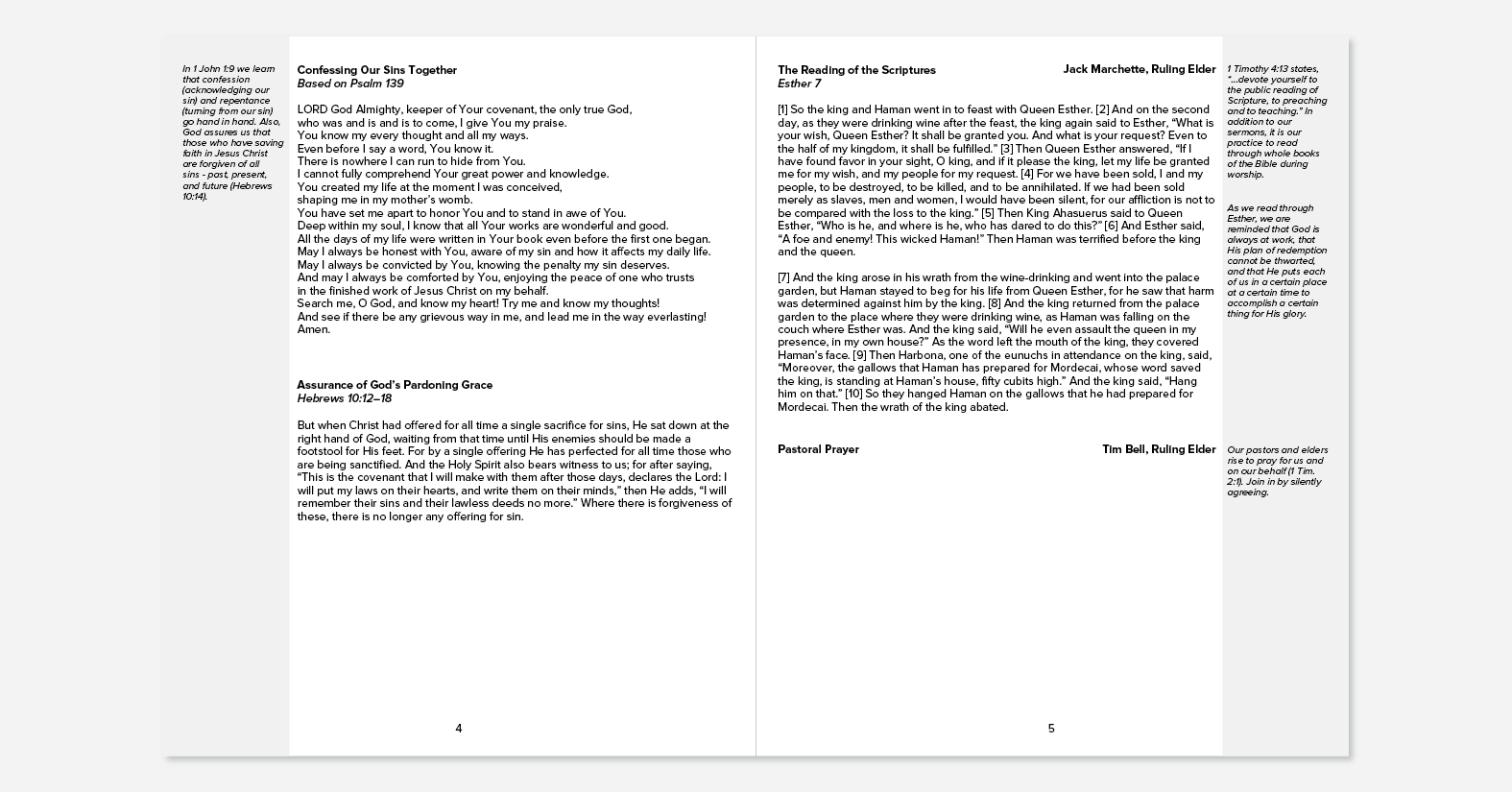
Look at what Paul says in verses 8 and 9. “8 Finally, brothers, whatever is true, whatever is honorable, whatever is just, whatever is pure, whatever is lovely, whatever is commendable, if there is any excellence, if there is anything worthy of praise, think about these things. 9 What you have learned and received and heard and seen in me—practice these things, and the God of peace will be with you.”
Paul gives a list of virtues that he encourages the Philippians to “think about.” This list isn’t covering a specific set of things and it certainly isn’t meant to be exhaustive. He’s speaking in general.
Look at all the good virtues he lists: truth, honor, justice, purity, lovely (what he means by lovely is agreeableness), commendability, and then he really summarizes his statement at the end of verse 8 by saying, if there is any excellence, if there is anything worthy of praise think about these things.
He’s encouraging folks to think about things that are morally and spiritually excellent. Christians pursue a righteous thought life because they are saved. A good thought life will not get you through the gates of heaven.
A commentator writing on this passage said, “...the virtue of which the apostle speaks is the fruit which grows on the tree of salvation.” Christians should dwell upon the virtues that are pleasing to God out of love for him.
There was a popular phrase that circulated in the evangelical world for a time that was used to characterize folks that thought about the Christian life too much.
If you knew someone like that you’d say, “Bob is so heavenly minded that he’s no earthly good.” The idea is that a person has his head in the clouds so much that he has a hard time actually getting stuff done.
But the truth is, that person doesn’t exist.
If you’re heavenly minded you’re of great earthly good. Look at verse 9. “What you have learned and received and heard and seen in me—practice these things, and the God of peace will be with you.” If you’re thinking about virtuous things, you’ll want to practice them.
What could possibly be more earthly good than to commit yourself to being a man or woman of truth, honor, fairness, purity and kindness? What could be better than you living a life pleasing to God? Your life is a direct reflection of what you believe!
But when things aren’t going well it’s tough to think righteous thoughts. In fact, it’s sometimes easier to assume the worst. It’s easy to let your thoughts eat away at you.
You see, peace from God comes through submitting to God’s will in prayer and living it out. God’s will is for you to not just have a righteous thought life but to live a righteous life out of love for him. If you live your life in humble submission to God you’ll have a sense of security that no one can ever take away from you.
As I looked at this passage as a whole a few things stood out to me. The first was the fact that the episode with Euodia and Syntyche was sort of jammed in the middle of this passage. Another thing that stood out to me was that Paul doesn’t really litigate the dispute between them. In fact, he doesn’t address the nature of their conflict at all. He simply mentions it.
There’s a real lack of transition between Euodia and Syntyche’s dispute to such powerful words of exhortation. We transition from dealing with a conflict in verse 3 to positive words of encouragement in verse 4.
I think Paul is teaching us something about resolving conflict, particularly among believers in this passage, which is this: sometimes the best way to handle conflict is to encourage people to rise above it.
There are times where it is more important for you to reflect upon who you are in Christ and what he’s done for you instead of how someone has wronged you. Too often we focus on the wrong things.
We want to focus on how we were offended. We want to focus on how someone sinned against us.But Jesus doesn’t do that with you and me. Jesus isn’t keeping a scorecard for those that have put their trust in him.
Praise God he doesn’t litigate our sins against him! No! He casts them as far as the east is from the west and says, “there is therefore now no condemnation for those who are in Christ Jesus.”
That’s only true for those that are trusting in Christ for their salvation. If you’re not in Christ, you will be judged based upon your sins. Everyone in the world is either in open conflict with God or reconciled to him by faith in Christ. Which are you?
The only hope any of us have for forgiveness is through faith in Christ. If you’ve experienced the forgiveness of your sins it’s possible to be a vessel of God’s grace.
When you recognize what a blessing you’ve received in Christ you’ll want to focus on the joy found in him, pray to him, and think about what pleases him. Paul acknowledges that Euodia and Syntyche - that their names were written in the book of life. He recognizes their relationship with Christ.
Sometimes we need to focus on joy in the Lord, pouring our hearts out in prayer, or reflecting on righteousness instead of who made us angry or how we’ve been wronged.
The person you are in Jesus Christ will always be stronger than any sin anyone has - or will commit against you and that is something to rejoice in.
Let’s pray together.